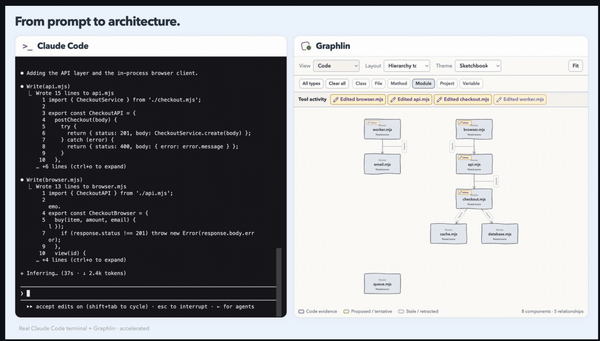
Introducing Graphlin - a plugin for Claude Code/Codex that auto visualises your architecture as your agent is building it, and what the agent is currently working on.
Why? I, like many others, tried Jev over the weekend. Unlike others, I
They're not really new, we just never really got to them - we just assumed they were there as a force of nature. Let's list them out (I'm sure there are more than this list)
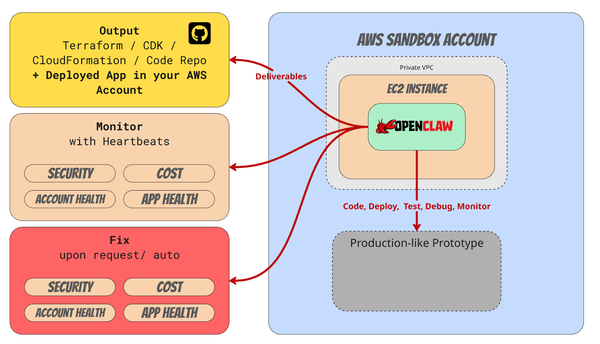
Give an agent a VM, it will submit PRs. Give an agent a deployment environment and an admin ability, and it will code, deploy, debug and monitor your apps.
I believe LowKey was the first I to have its own
No more MSI. No more dragging. No more downloading.
A well crafted bootstrapping prompt provided to your users can mean you can create ever more complex tools and apps that might be terrible to install from a human-perspective, but
production-shaped prototype in a separate cloud environment
This is all me just brain-storming with myself, and I'd love to hear what people think about this. For background Loki is a builder agent based on openclaw designed
Software engineering practices were (at least when I'm pushing them) all about minimizing things for humans:
* minimize how much a person needs to read to understand the meaning of something,
* how many things a person needs to change
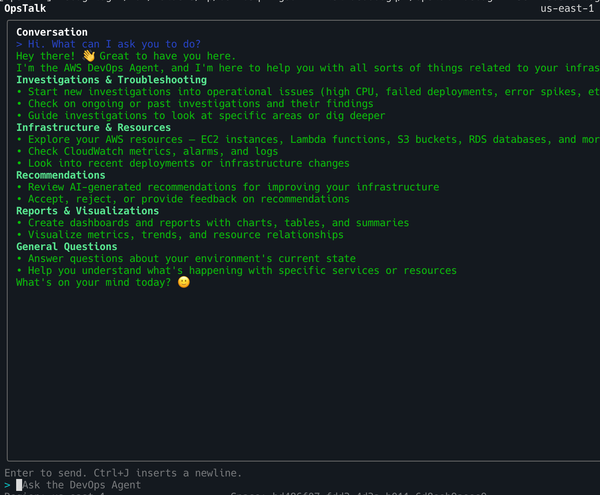
So, I think Devops Agent is great. I went ahead and built a small CLI to talk to it directly from my terminal. I think it's pretty cool and makes it easy to jump in and investigate things
I've spent probably hundreds of $ on loki-agent's code. And spending more every day. It's code that combines:
* My expertise and architectural vision and creative ideas
* My token budget
When I open source it,
It's hard to believe OpenClaw (read "ClawdBot") was released only about 4.5 months ago. Nov 24 Openclaw was released on Github publicly. It's been making history ever since.
I'll treat it
Happy to release bedrockify: An OpenAI Completions compatible API with embeddings proxy API for bedrock usage. Many of the current agents don't support bedrock by default, but do support custom OpenAI api. This gives a proxy you can
This Entry is an Experiment in creating a definition of what stateful agents are along side Opus 4.6. It's based on a technique I read about in Andrej Karpathy's Post:
- Drafted a blog post
- Used
Now It Codes, Deploys and Debugs Full Stack Apps. It's the full loop.
I'm doing it through a deployment harness I created that I call Loki. You can find it here: https://github.com/inceptionstack/loki-
PSA: embedrock has been superseded by bedrockify which contains both the embedding and the completions inference proxy
embedrock is a tiny Go proxy I created (ok, my agent did) that translates OpenAI's /v1/embeddings API to Amazon Bedrock,
I asked OpenClaw with opus 4.6 to deep dive into its source code and create a detailed architecture document. I like the output for this and I think others could find use for it since I didn't see it described in this detail so far.
As an architect, I love doing diagrams. I think visually. In the past I loved using Miro, mermaid, and a bunch of others, but only recently (past week!) did I try and experiment with drawIO and its XM files format.
What better time is there to try out a new tool or service than when joining a new company? Well, I just recently joined AWS as a Sr. Solutions Architect. Yay! And that's my opportunity to try out
A common thing for me and other developers I see do (I was first alerted to this by Harel Coman) .
We work mainly with cursor but a few use claude code. But a common pattern is this:
Start chat, then:
A while ago I wrote about Zero-Touch Algorithm Handoffs: How We Ship ML Algorithms to Prod Without Rewrites (or ML Engineers) and a few weeks ago I got the chance to speak about this topic at the BuildStuff conference.
In a previous blog post I wrote about RepoSwarm: Give AI Agents Context Across All Your Repos . A few weeks ago I spoke at BuildStuff conference about this tool including a deep dive into its architecture and what you can
My colleague, Harel Coman, wrote about a new AI-driven code review pattern he's been implementing lately called Red Queen Code Review. I like this idea. If I had to put it in a sentence:
Every Code Review
I don't know when or how I'll use all of these, but I love the scripts listed here.
Some that caught my eye:
boop (an alias, not a shell script) makes a happy sound if the
I've been slowly getting back into public speaking, as I've been "in the trenches" for the past few years (working on my own startup was a huge journey).
Anyway here's what I&
OK. This is Big. If you don't know who Andrej Karpathy is, please get to know him and all of his amazing writing and projects.
💡If you're a hands-on developer, I recommend Karpathy's
My extremely talented colleague, Harel Coman, wrote a new blog post about how he uses AI augmented coding with Cursor as a frontend tech lead. He ended up developing his own method which works well for him, and documenting it.
AI agentic coding has enabled so many possibilities now. Every domain I ever bought and never used is now sitting there, closer than ever, waiting for me to start that project "this time for real".
Every little coding
TLDR; see main image of this post, and this is the structure:
AI Stack
│
├── Day-to-Day Chat
│
├── Development Centric
│ ├── AI Coding Tools
│ └── Background Coding Agents
│
├── Research Centric
│ ├── AI Studio (Research)
│ └── Model Training, Eval & Lifecycle
│
├── Production Facing
│ ├── AI Gateways
TLDR;
Go see it here.
Intro
Let's say you have 400+ repositories in your company. And you're:
* A software architect that needs to understand what monitoring tools are used across all the repositories, and you want
Since vibe-coding began, the enshitification of code and making throw-away stuff have become very easy. I think projects like Spec-Kit are there to help mitigate this, and not a moment too soon.
I think we'll
Now that cursor has added the concept of custom commands, we can put stuff like this in our repository:
.cursor/commands/get-started.md:
# Initialize Dev Environment for developer
- greet the developer who's about to use this project,
TLDR;
ML Algorithm integrations were (for us) a frustrating experience of re-implementations, duplicate work, and endless back-and-forth.
We cut through that by abstracting research algorithms under Temporal activities and letting workflows that run them be maintained by